By: Ismail Oluwapelumi
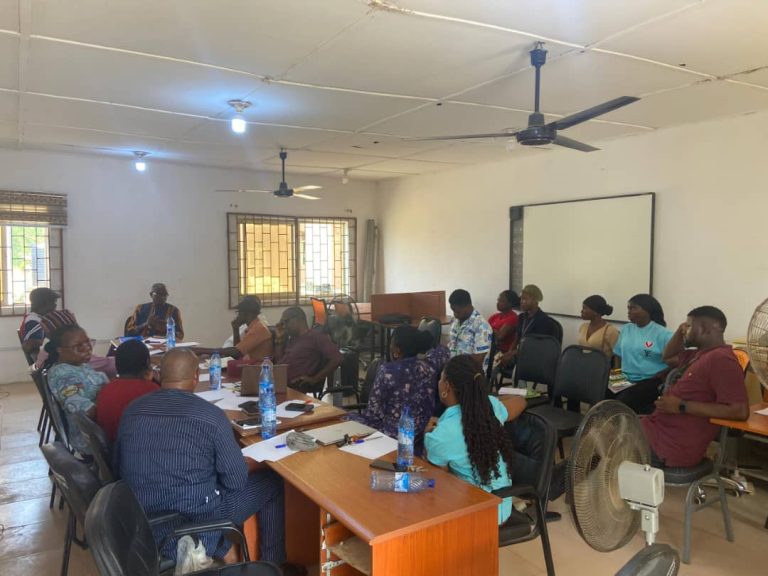
Public Administration Department holds re-orientation programme aimed at strengthening project supervision and improving the quality of research writing among lecturers and students on Tuesday, January 28, 2025.

The programme brought together academic staff, external participants, and student leaders to address key challenges affecting research output and project writing.
The event featured Dr. Taiwo of the Department of Geography, University of Ibadan, as the guest speaker. He emphasized the need for researchers to clearly define their research objectives and ensure proper alignment with publications. According to him, effective evaluation of research impact is crucial for achieving meaningful academic outcomes.
He warned that poor training and incorrect enumeration could negatively affect research quality, publication standards, and performance measurement.

Speaking at the programme, the Head of Department, Dr. O. O. Oyewo, stressed the importance of clearly defined standards in measuring performance. To illustrate his point, he likened research evaluation to public performance during elections, where outcomes are easily observed and assessed. He also highlighted the need for synchronizing research objectives with hypotheses to ensure coherence and clarity in academic work.
Other lecturers contributed to the discussion. Mr. Y. B. Wahab advised researchers to ensure that their objectives are realistic, achievable, and clearly addressed in their studies. Dr. Adeyeye expressed concern over students’ increasing dependence on cybercafé operators for project topics, noting that such practices reduce the quality and originality of academic work. The speakers also cautioned against excessive reliance on Artificial Intelligence (AI) in academic writing.
The programme further emphasized that students must demonstrate genuine interest in their research topics and possess a clear understanding of their chosen areas of study. Discussions also covered the basics of generalization in research, the role of theories in identifying variables, formulating hypotheses, and selecting appropriate methods of analysis. Participants were encouraged to rely on credible sources, particularly academic journals, and to adopt globally accepted research formats to minimize errors.
Issues relating to data sources, research methodology, statistical analysis, and the proper presentation and discussion of research findings were also examined. Mr. Oke and Mr. Wahab provided insights into best practices in handling these aspects of research.

In attendance were lecturers from the department, including Dr. O. O. Oyewo, Mr. Y. B. Wahab, Barrister Diekola, Mrs. Oke, Barrister Adebayo, Mrs. Olaoye, Dr. Adeyeye, Mr. Akinola, Dr. Oyewo, and Mr. Ganiyu. External participants present included Ogunremi Gbolahan, Ajisola I. Salawu, Bobade David, Azeez A. Lukman, and Egunjobi G. O. Student leaders, led by the Departmental President, Comrade Aluko Adedeji David, and other departmental executives, also attended the programme.
In his closing remarks, Barrister Diekola appreciated the speakers and participants for what he described as a successful and enlightening session. Mr. Wahab suggested that the presentation handouts be made available to students and shared with other departments.
However, the Head of Department, Dr. O. O. Oyewo disagreed, citing the proverb that one should “reshape one’s own head before reshaping others,” and stressed the need for the department to first improve internally. He also proposed the establishment of a departmental journal to educate both students and lecturers and called for stronger collaboration between lecturers and students.
About The Author